Read Before You Cut: A Field Guide to Altering Tablets and Capsules Safely
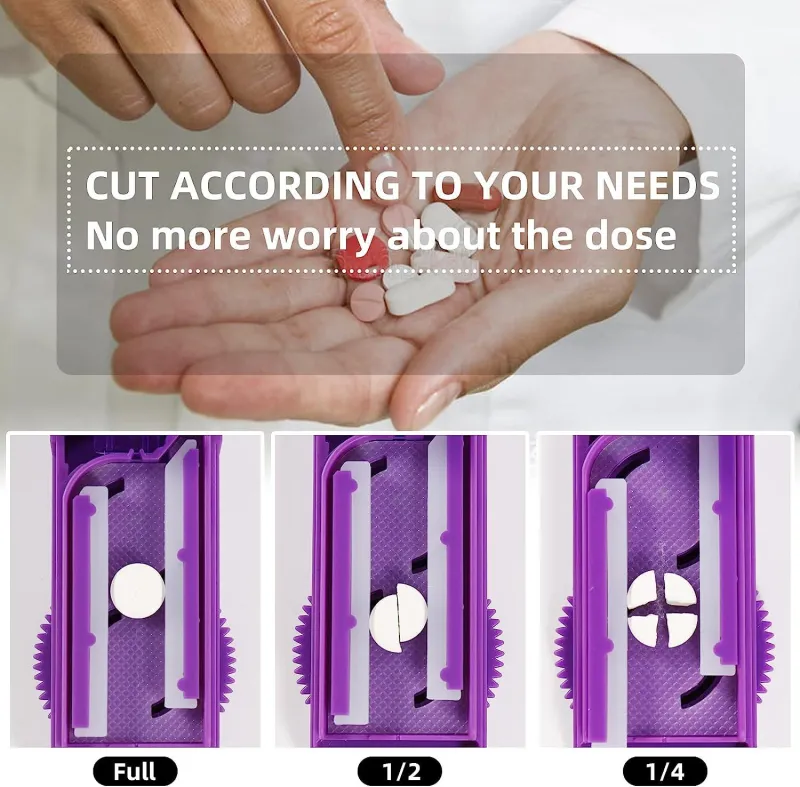
Photo: pill splitter cutting tablet in half on white countertop, via www.gosupps.com
Somewhere in America tonight, someone is crushing a pill into applesauce, snipping a capsule over a spoon, or slicing a tablet with a $4 splitter from the drugstore aisle. Some of those alterations are perfectly fine. Others turn a carefully engineered delivery system into a hazard.
The difference lies in how the medication was designed to behave inside the body — information that is often printed on the label, if you know what to look for.
Why Formulation Is Part of the Dose
A tablet is not just powdered drug pressed into shape. It is a delivery mechanism. Some formulations release medication within minutes; others are built to trickle a dose out over 12 or 24 hours. Some are coated to survive stomach acid and dissolve in the intestine. Others are layered so that an immediate release and a slow release occur from the same pill.
Altering the physical form can break the mechanism. Crush an extended-release tablet and its entire payload — sometimes two or three times the intended immediate dose — enters the body at once. Cut a coated tablet and the protective layer that shielded the stomach lining is gone.
The Warning Signs on the Label
Certain words on a prescription label or package insert should stop any splitting or crushing in its tracks:
- Extended-release, sustained-release, controlled-release (often abbreviated ER, SR, XR, XL, or CR)
- Enteric-coated or EC, meaning the coating is designed to bypass the stomach
- Delayed-release or DR
- Sublingual, buccal, or disintegrating tablets, which depend on specific placement or absorption routes
- Explicit instructions such as "do not crush" or "swallow whole"
Over-the-counter products follow the same logic. Many OTC pain relievers and cold medications come in extended-release forms, and the same rules apply to them as to prescriptions.
When Altering Is Reasonable
Plenty of medications tolerate — and sometimes invite — modification:
- Immediate-release tablets with a score line are generally intended to be split. The groove is a manufacturing signal.
- Some unscored immediate-release tablets can be split with pharmacist approval, though uneven halves mean uneven doses, which matters more for narrow-therapeutic-index drugs.
- Chewable tablets and oral liquids exist precisely for patients who cannot swallow pills; asking whether a liquid or chewable version of your drug exists is often the safest solution of all.
The decisive step is a question to the pharmacist: "Can this be split, crushed, or opened?" It takes seconds, and pharmacists answer it routinely.
The Higher-Risk Cases
Extended-release formulations of opioids, stimulants, and certain cardiac medications deserve particular caution. Altering these can cause dose-dumping — a rapid, uncontrolled release that produces excessive sedation, dangerous blood pressure drops, or other serious effects. Enteric-coated aspirin and some proton pump inhibitors lose their stomach protection when crushed, exposing the esophagus and gastric lining to irritation.
Patients with swallowing difficulties, feeding tubes, or conditions affecting the esophagus face these decisions constantly. The correct answer is rarely improvisation; it is a formulation change — a liquid, a patch, an immediate-release alternative — arranged with the prescriber.
Practical Habits at Home
- Keep a pill splitter for scored tablets rather than using knives, which produce crumbled, uneven halves.
- Do not split more than one tablet's worth at a time; humidity and light degrade exposed medication.
- If a crushed dose must be given (with pharmacist approval), mix it with a small amount of soft food and take it immediately rather than storing it.
- Store splitters clean and dry, and replace them when the blade dulls.
The Bottom Line
The pill's shape is not cosmetic. It is pharmacology in solid form. Before you cut, crush, or crack anything in your medicine cabinet, read the label for release-type language, and when in doubt, bring the bottle to the pharmacy counter and ask. The answer costs nothing and may prevent the kind of mistake no one sees coming.